

The Implementation of the Aarhus Convention in Kazakhstan: Progress and Achievements
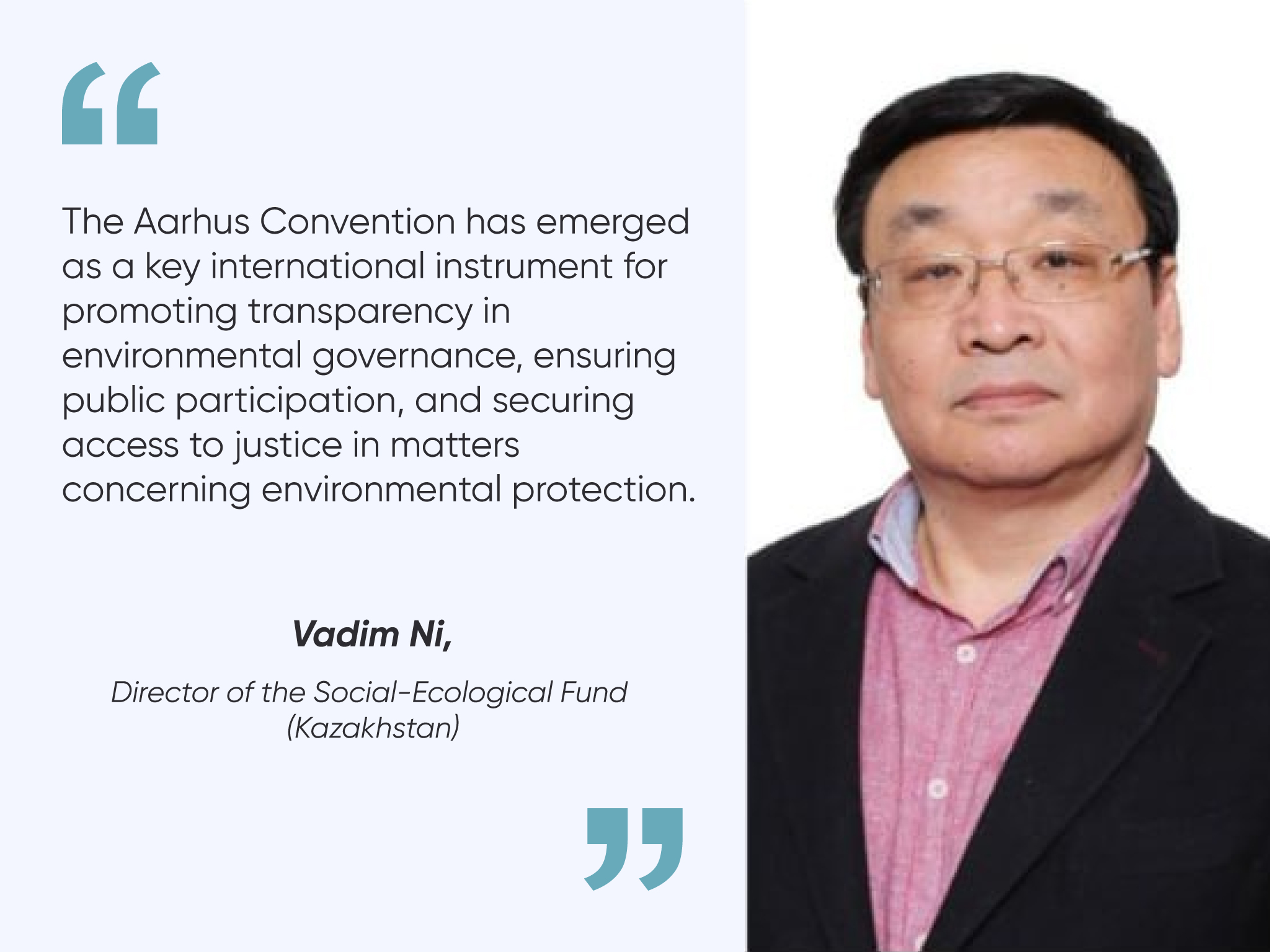
The Aarhus Convention has become a key international instrument for ensuring transparency in environmental governance, public participation, and access to justice in environmental matters.
Kazakhstan joined the Convention's implementation in the early 2000s. Over the years, the country has made significant progress—from its initial steps in disclosing environmental information to the establishment of institutionalized mechanisms for public oversight and judicial protection of environmental rights.
The Three Principal Pillars of the Aarhus Convention
Under national legislation, the right-holders are recognized as natural persons, legal entities—particularly non-governmental, non-profit organizations—and the public at large, especially with respect to participation in decision-making processes.
Access to environmental information is ensured and regulated through both passive and active approaches. In the passive approach, information is provided upon request, while in the active approach, government authorities proactively disseminate it. A notable shift is underway from paper-based information to digital formats.
The main procedures for public participation in environmental matters include:
- Environmental impact assessment (EIA);
- Public discussion of draft regulatory acts;
- Strategic environmental assessment (SEA).
Access to justice is primarily facilitated through judicial procedures, as well as through complaints submitted to higher authorities and human rights institutions.
Access to Environmental Information
Access to environmental information in Kazakhstan is regulated by both the provisions of the Environmental Code and the Administrative Procedural and Process Code.
The Environmental Code establishes specific provisions regarding environmental information, including tools for its dissemination by government authorities. The Administrative Procedural and Process Code outlines the general procedure for requesting information.
Requests can be made electronically via the portal https://eotinish.kz/ using a digital signature. Alternatively, requests can be submitted in paper form by mail or delivered directly to the office of the relevant government authority. However, the use of paper requests is becoming increasingly less common. Requests are typically processed within 15 business days. Responses are not always complete, but oversight is in place to ensure that requests are addressed. Most government agencies have websites, and the active dissemination of environmental information is supported through specialized portals—covering EIA (Environmental Impact Assessment), draft regulations, judicial decisions, and statistical data.
Public Participation
In Kazakhstan, public participation in environmental matters is governed by the provisions of the Environmental Code, subordinate regulations, laws on public councils, and other normative legal acts.
In particular, the Environmental Impact Assessment (EIA) procedure is actively developing. Within this framework, environmental aspects of proposed economic activities are subject to public discussion. Public participation is conducted in the form of public hearings, often with the option of remote attendance via Zoom. Information about upcoming hearings is published on the ecoportal (ecoportal.kz), on the websites of relevant government agencies, and in the media.
There is also a procedure for the open discussion of draft normative legal acts, including programs, strategies, plans, and policy concepts. Participation in these discussions is available through the Public Review Portal of Draft Regulations via the submission of written comments.
As of January 1, 2024, a Strategic Environmental Assessment (SEA) procedure has been introduced for state programs, territorial development plans, and urban master plans. However, it has not yet been applied in practice.
Access to Justice
Procedures for public access to justice in environmental matters are governed by the provisions of the Administrative Procedural and Process Code and the Civil Procedure Code of the Republic of Kazakhstan.
Where claims are filed against state authorities, such cases fall under the jurisdiction of specialized administrative courts and are adjudicated in accordance with the Administrative Procedural and Process Code. In cases involving private individuals or legal entities, the provisions of civil procedural law apply, and such disputes are heard by courts of general jurisdiction or specialized economic courts.
In Kazakhstan, members of the public relatively actively pursue environmental disputes through the courts—more frequently against governmental bodies, and less often against private individuals or companies. Judicial practice covers a broad range of issues, including access to environmental information, public participation in environmental impact assessments (EIA), and violations of environmental legislation. The public often prevails in cases related to access to information, and there are notable precedents involving successful claims concerning breaches of environmental law.
However, in cases involving private parties, certain barriers persist: higher court fees, the risk of counterclaims, and potential liability for the opposing party’s legal costs.
Vadim Ni
Director, Social-Ecological Fund (Kazakhstan)