

Report on the Survey Results Concerning Parks and Green Spaces in Tashkent

In May 2025, the Yuksalish movement conducted a public survey entitled 'How can we improve Tashkent's parks? Public Opinion from City Residents”.
The survey aimed to identify the needs and expectations of city residents regarding parks and green spaces, and to develop recommendations for improvements to these areas.
This report presents an analysis of public perceptions of Tashkent’s parks and green zones, including their current functions and usage patterns, as well as citizens’ aspirations for their enhancement. The survey covered the following key areas: frequency of visits to parks, levels of satisfaction, identification of existing issues, desired features in new or renovated parks, perceived need for additional green spaces, and suggestions for improvement.
A total of 403 residents aged 18 and over participated in the survey. Among them, 56.3% were women and 43.3% were men.
Respondents were geographically diverse, hailing from districts such as Mirzo Ulugbek, Yunusabad, Chilanzar, Almazar, Yakkasaray, Shaykhantakhur, Sergeli, Bektemir, Yangihayot/Yashnobod and Uchtepa. This broad distribution highlights the comprehensive reach of the survey across the capital.
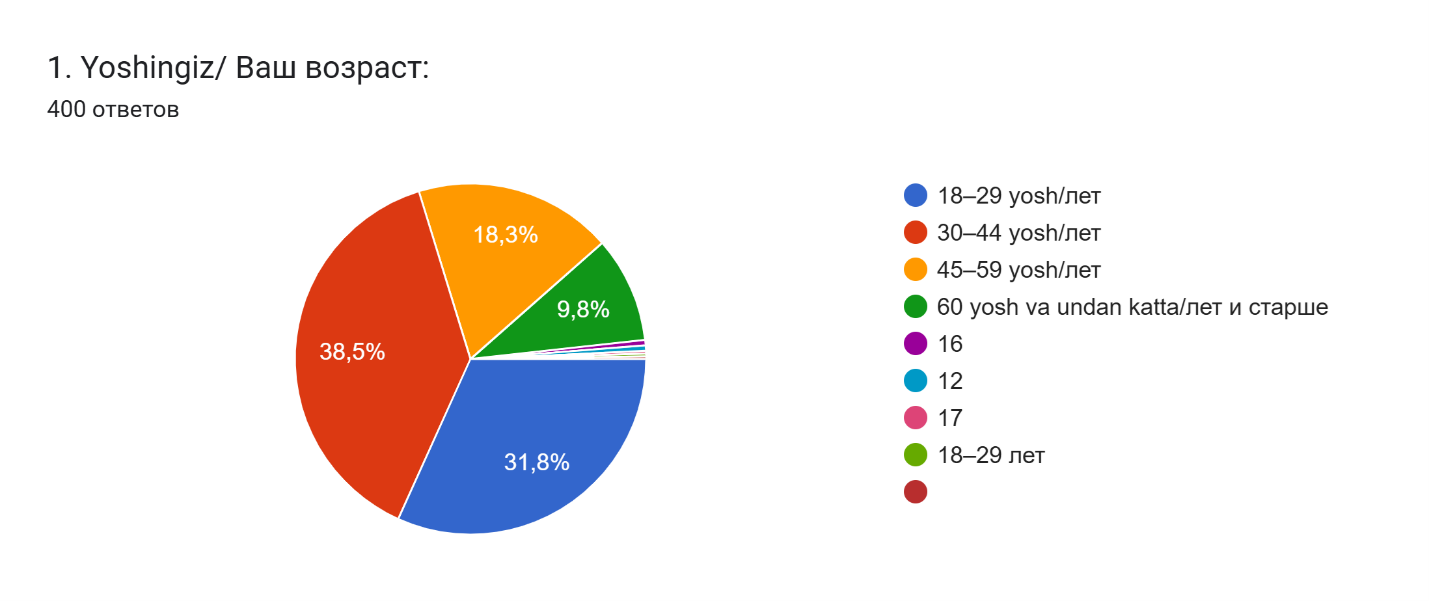
- Your Age:
400 responses
18–29 years – 31.8%
30–44 years – 38.5%
45–59 years – 18.3%
60 years and older – 9.8%
16
12
17
18-29 years
The question regarding the frequency of park visits yielded the following responses:
32.3% of respondents indicated that they visit parks several times a week;
32.6% stated that they visit parks once a month;
28.3% reported visiting parks very rarely;
5.8% stated that they visit parks daily.
Only 3 participants reported that they do not visit parks at all.
- In which district of Tashkent do you reside?
394 responses
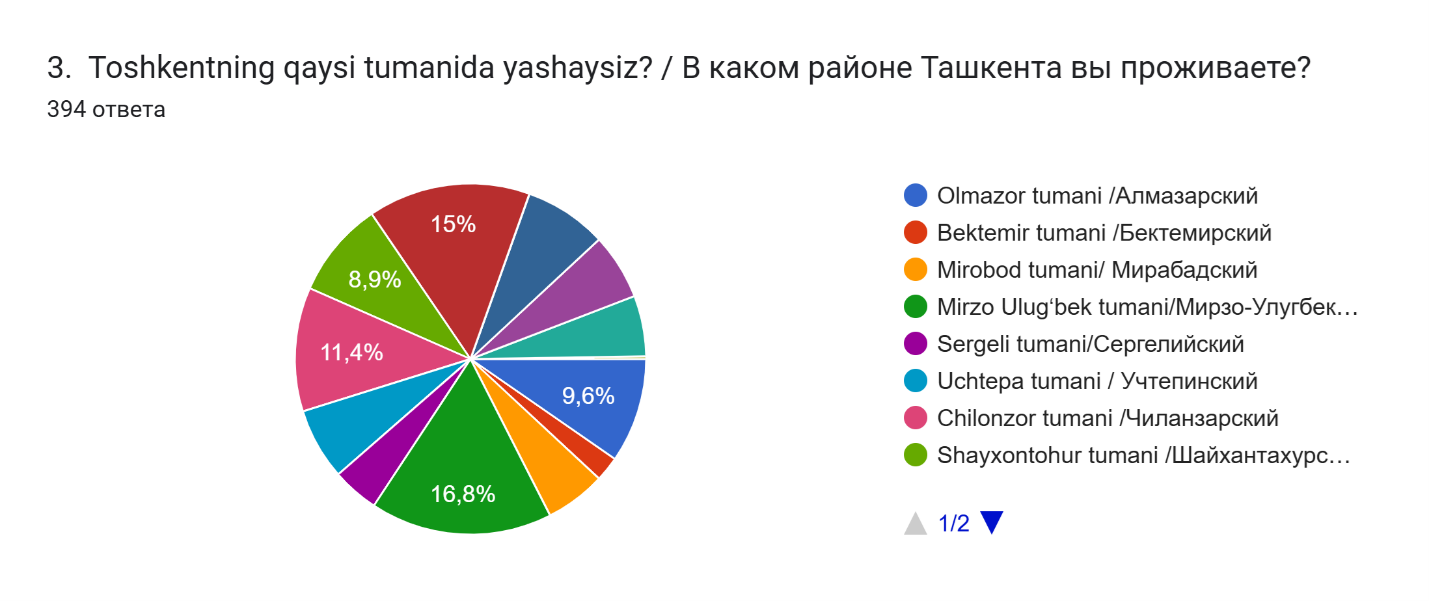
- Shaykhantakhur district – 15%
- Sergeli district – 16.8%
- Chilanzar district – 11.4%
- Olmazor district – 9.6%
- Mirobod district – 8.9%
- Uchtepa district
- Mirzo Ulugbek district
- Bektemir district
The parks and green areas in Tashkent that are most frequently visited, as identified by survey respondents, are as follows:
- Tashkent City Park – 35%
- Gʻafur Gʻulom Recreation Park (Dream Park): 31.2%
- Magic City – 29.7%
- Kok Gumbazlar Boulevard – 23.9%
- Anhor-Lokomotiv Recreation Park – 23.2%;
- Japanese Garden – 22.4%
- Zahiriddin Muhammad Babur Central Eco Park: 20.9%
- Ulugbek Central Park – 19%
- Friendship Park (formerly Babur Park): 15.9%
- New Uzbekistan Park – 14.4%
- Navoi National Park – 13.9%
- Ashgabat Park: 12.8%
- Lokomotiv Park – 12.1%
- Victory Park – 9.6%
- Furqat Park: 7.6%
- How often do you visit recreational parks in Tashkent?
399 responses
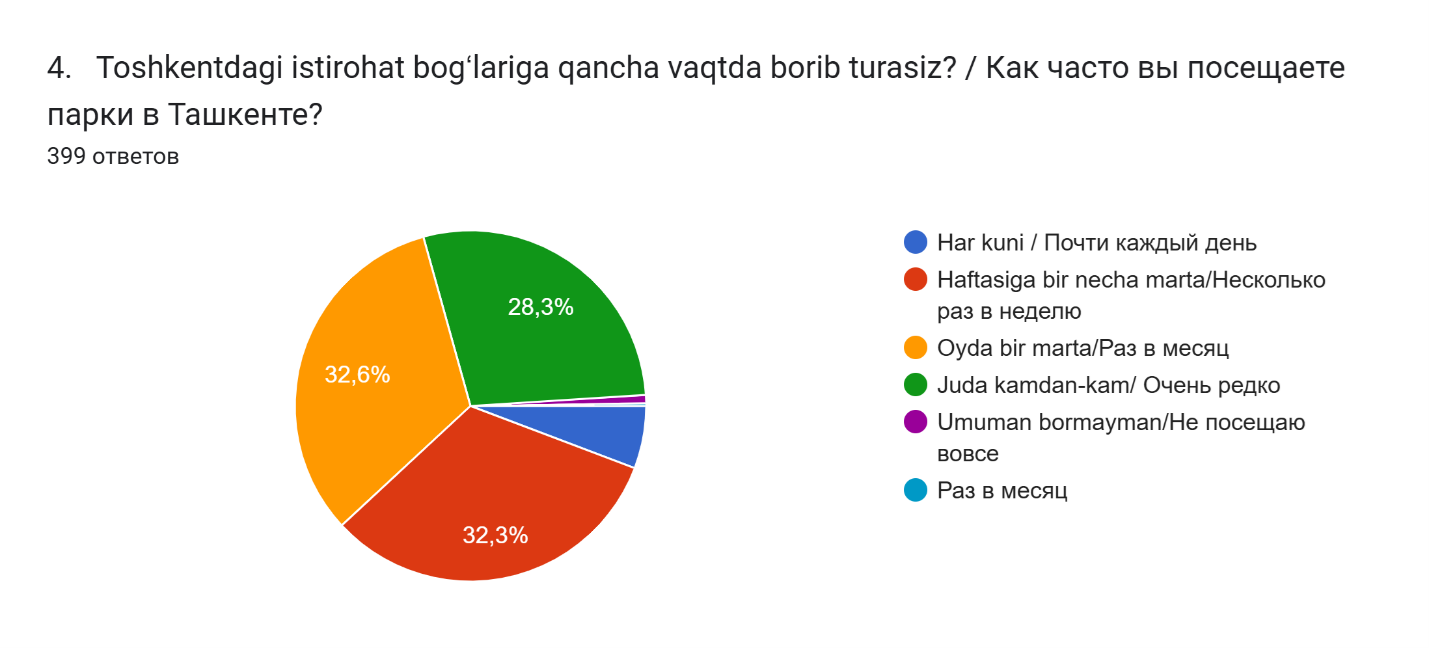
- Every day – 5.8%
- Several times a week – 32.3%
- Once a month – 32.6%
- Very rarely – 28.3%
- Do not visit at all
- Once a month
The following locations were also mentioned by respondents: the Botanical Garden, “River” Park, Abdulla Qodiriy Park, “Sunshine” Park (located in the Bektemir district), “New Sergeli” Park, Writers’ Alley, and Amir Temur Boulevard.
In the subsequent question, respondents were asked to express their level of satisfaction with the condition of parks in Tashkent.
Satisfaction with the Condition of Parks and Identified Issues
According to the survey results, the most frequently selected response was “Overall, I am satisfied, but there are shortcomings” (57.7%). This indicates that while respondents generally have a positive perception of the parks, their needs are not being fully met.
- A significant proportion of respondents (30.9%) highlighted the existence of serious problems.
- Additionally, 7.6% of participants stated that they are entirely dissatisfied with the current condition of the parks.
- Only 3.8% of respondents reported being completely satisfied with the state of the parks.
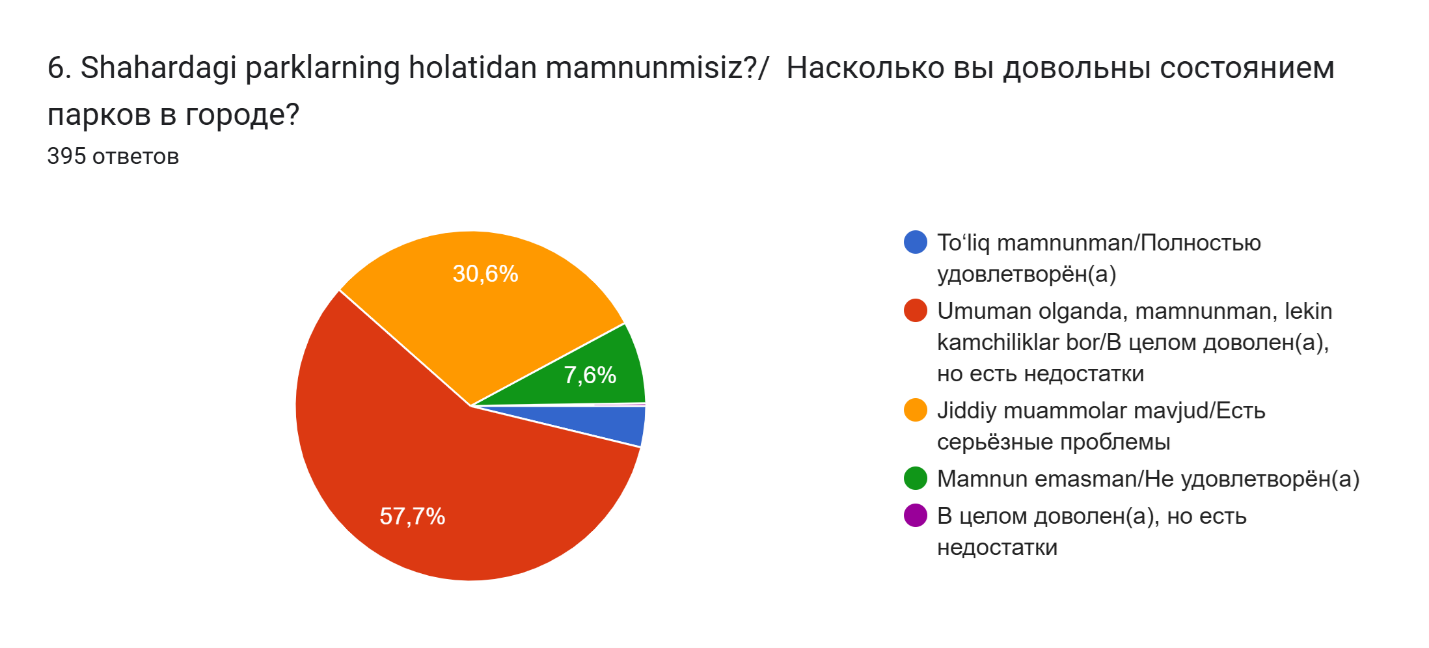
6. How satisfied are you with the condition of parks in the city?
395 responses
Fully satisfied – 3.8%
Generally satisfied, but there are shortcomings – 57.7%
There are serious problems – 30.6%
Not satisfied – 7.6%
- Generally satisfied, but there are shortcomings
Among the existing issues in parks, the following were most frequently reported:
- Lack of greenery and shaded areas – 73.9%. This was the most commonly mentioned problem across nearly all responses.
- Insufficient benches and canopies – 66.3%
- Waste management and hygiene issues – 45.8%
- Noise and disorder (often associated with loud music and amusement rides) – 36.2%
- Lack of accessibility and facilities for persons with disabilities – 37.5%
Additional shortcomings noted by respondents included:
- Shortage of children's and sports playgrounds
- High prices
- Absence of lighting and security systems
- Insufficient number of free play areas
- Lack of waste bins, among other concerns
Desired Features in New or Renovated Parks
The primary demand expressed by respondents was for “an increase in green areas.” This directly addresses the most critical issue identified in the survey, with 87.2% of participants selecting this option.
In addition, respondents highlighted the following preferences:
- Open-air libraries / reading corners – 53.1%
- Creative zones / master classes – 44.3%
The survey also revealed a strong need among residents for the following amenities and spaces:
- Areas designated for family recreation
- Bicycle lanes and running tracks
- Ethnic zones (cultural and ethnographic areas)
- Cultural events
- Sports courts (tennis, basketball, volleyball)
- Fountains, water features, and canals
- Environmentally friendly picnic areas
- Spaces for yoga and meditation
- Clean public restrooms
- Dedicated waste bins
- Free playgrounds for children
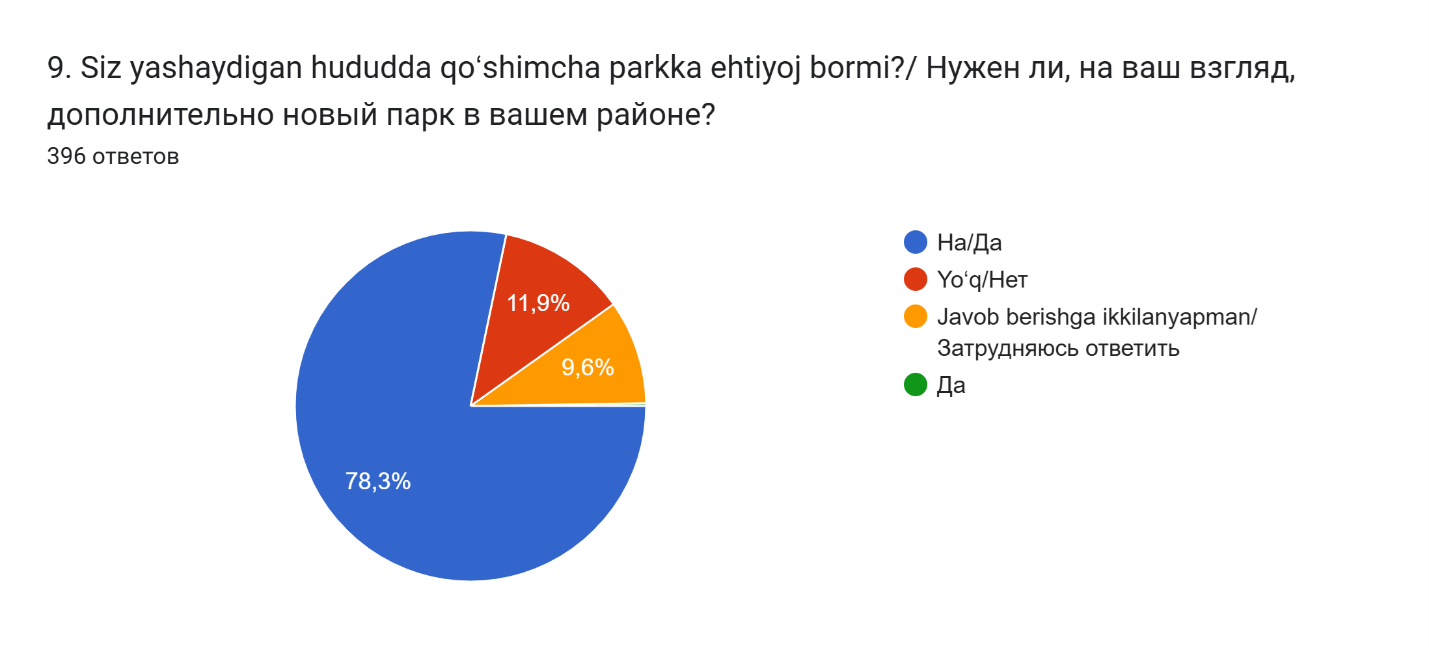
9. In your opinion, is there a need for an additional park in your residential area?
396 responses
- Yes – 78.3%
- No – 11.9%
- Unsure / Difficult to answer – 9.6%
- Yes
Is there a need for an additional park in your residential area?
Demand for Additional Parks and Proposed Ideas
In response to the question of whether there is a need for additional parks near respondents' places of residence:
- The majority answered 'Yes', indicating a high overall demand for parks across the city.
- This need was particularly emphasised in the Yashnobod, Sergeli and Qumariq (near the third airport) districts.
An analysis of the 178 open-ended responses to the question 'How can Tashkent's parks be improved?' revealed the following thematic categories:
A. Greening
- Planting large, shady trees (such as plane trees, oaks, and conifers)
- Preserving existing trees and prohibiting their removal
- Implementing vertical and landscape-style greening approaches
B. Peace and Tranquility
- Increasing the number of parks without loud music and amusement rides
- Reducing commercial outlets within parks
- Creating quiet relaxation zones
C. Amenities
- Increasing the number of benches and canopies
- Developing high-quality pedestrian paths and bicycle lanes
- Installing lighting, security, and video surveillance systems
- Providing clean public restrooms and drinking water fountains
- Building sports grounds and yoga zones
- Installing play complexes for children
D. Equal Access for All
- Developing infrastructure for persons with disabilities
- Ensuring free or affordable entry
E. Management
- Regular cleaning and maintenance
- Monitoring to ensure order and safety
- Proper irrigation and care of vegetation
Key findings:
-
- There is a very high demand for greenery and shaded areas—this was the most frequently cited issue among respondents.
- There is a strong preference for “natural” parks—residents favor quiet, green recreational spaces over commercial areas filled with attractions.
- Basic park infrastructure requires improvement, including the provision of more benches, canopies, clean restrooms, waste bins, and pedestrian pathways.
- Parks should be accessible to all, both physically and financially, ensuring inclusivity.
- There is a need for new parks—many districts lack sufficient green spaces, and the public’s demand in this regard is clearly evident.
Recommendations Based on the Study Findings:
- In the reconstruction of existing parks and the development of new ones, priority should be given to planting large, shady trees and expanding green areas.
- Clear zoning within parks should be implemented: designated active areas (for sports, attractions) and larger quiet zones (for rest, reading, walking) must be provided.
- The policy on the placement of commercial outlets and attractions should be revised in favor of preserving recreational and green spaces.
- Every park should be equipped with the following basic infrastructure: an adequate number of benches, separate waste bins, clean and free public restrooms, drinking water fountains, and a lighting system.
- The network of bicycle lanes and pedestrian pathways should be expanded.
- Authorities should maintain regular communication with the public and actively involve residents in the planning and development of parks.
- Existing green zones must be strictly protected, and any transformation of these areas into construction sites should be prevented.